
Vendor due diligence is what it sounds like: you pressure-test your business before buyers do. It’s a seller-commissioned review of the numbers, risks and commercial story, designed to stop avoidable issues surfacing late, when you’ve got the least leverage.
Done well, it doesn’t just ‘tidy things up’. It changes the tone of the whole deal. Buyers move from suspicion to verification, and negotiations stay anchored to evidence rather than assumptions.
What you’re actually buying with vendor due diligence
Vendor due diligence (often called sell-side due diligence) is a structured review you commission as the seller, usually with support from advisers. It focuses on the areas buyers typically pick apart during diligence so you can do three things earlier:
- Confirm what’s genuinely repeatable (profit, margins, performance)
- Identify the risks that will affect price or terms
- Prepare clear evidence and explanations so you’re not improvising under pressure
That last part matters more than most owners realise. A ‘good business’ can still take a valuation hit if the story is hard to prove, the information arrives slowly, or key questions get answered differently each time.
Vendor due diligence gets confused with a few related things. Here’s the clean distinction.
- It is not a valuation. A valuation is a range or view of what someone might pay. Vendor due diligence is about making the business easier to underwrite.
- It is not buyer due diligence. Buyers will still do their own checks. This doesn’t replace them.
- It is not a glossy ‘sales pack’. If it reads like marketing, it will be treated like marketing.
The goal is credibility. Not perfection.
Why it protects value
Most value gets lost in two moments:
- When confidence drops
A buyer starts believing there’s something they haven’t seen, or the numbers don’t fully hold up. They protect themselves with price reductions, tougher terms, or slower pace. - When time drags on
Long timelines create fatigue. Staff get twitchy. momentum fades. Buyers start ‘shopping around’ again. Late-stage surprises become expensive because you’ve already invested time and emotional energy.
Vendor due diligence protects value by keeping the process grounded in evidence, reducing the number of unknowns, and preventing avoidable surprises becoming negotiation weapons.
What buyers are really trying to prove
Buyers aren’t only asking ‘is this business profitable?’ They’re asking:
- Is the profit repeatable, or does it rely on a few fragile conditions?
- Are there any hidden liabilities that will surface later?
- Can the business transition without a drop-off when the owner steps back?
- Are the numbers clean enough to trust, and consistent enough to underwrite?
Vendor due diligence helps you answer those questions in a way that feels calm and controlled, rather than reactive.
What vendor due diligence typically covers
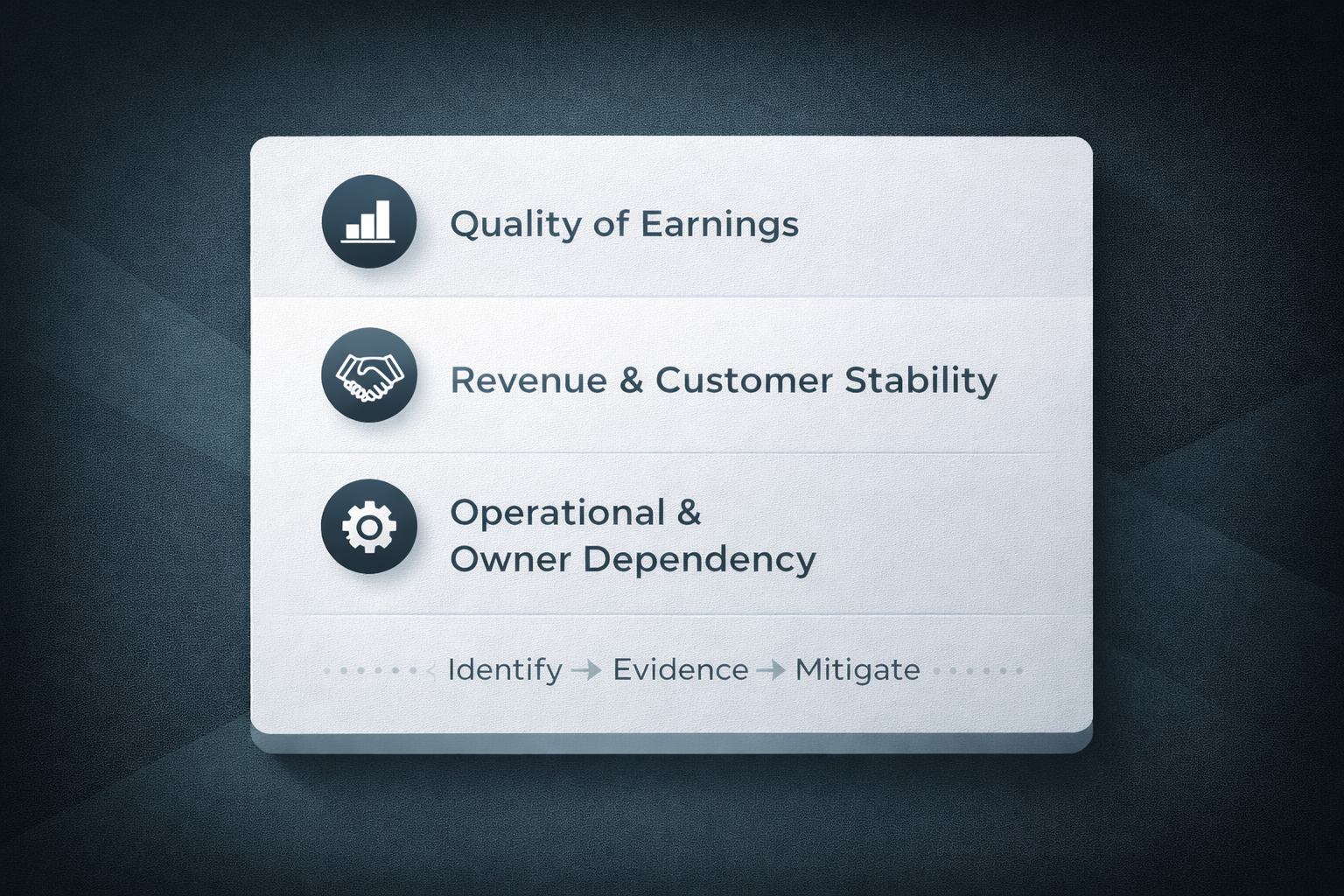
The exact scope varies by sector and deal size, but most SME sell-side reviews focus on three core areas.
1) Financial quality of earnings
This is where deals often get bruised, not because the business is bad, but because the evidence isn’t tight.
Typical focus areas include:
- Sustainable profit versus one-offs (exceptional costs, unusual contracts, unusual timing)
- Margin movements and what caused them
- Working capital patterns (including seasonal swings)
- Owner remuneration and adjustments (what changes post-sale)
- Cash conversion (profit is not cash, and buyers know it)
If you can explain your numbers quickly and consistently, you reduce buyer doubt. If you can’t, they assume risk.
2) Commercial and customer risk
Buyers are trying to work out whether revenue is stable for reasons that will still exist after the sale.
This is where they look hard at:
- Customer concentration and the strength of those relationships
- Contract terms, renewal risk, and informal agreements
- Pipeline reality versus optimistic forecasts
- Pricing power and churn risk
- Supplier concentration or key dependency
A business can look strong on paper and still be priced cautiously if one or two relationships carry too much weight.
3) Operational and people dependency
This is less about spreadsheets and more about whether the business can run without specific individuals.
Buyers will probe:
- Owner dependency (especially sales, quoting, approvals, key relationships)
- Key person risk in the team (knowledge stuck in one head)
- Handover feasibility and timeline
- Systems and process maturity (even if informal, can someone follow it?)
- Compliance basics that can create liabilities (contracts, licences, HR paperwork)
If the business requires constant owner intervention, buyers either discount value or push for earn-outs and deferred consideration to protect themselves.
What ‘good’ looks like for an SME
Vendor due diligence doesn’t need to turn your business into a corporate machine. It just needs to make the fundamentals defensible.
A strong SME position usually looks like:
- Numbers that reconcile cleanly and can be explained without backtracking
- A clear picture of what’s repeatable and what’s not
- Risks identified early, with a plan to mitigate or frame them
- Key documents organised and ready (so diligence doesn’t become chaos)
- A realistic transition plan that reduces dependency
You don’t need to eliminate every risk. You need to show you understand them and that buyers won’t discover them the hard way.
Is vendor due diligence worth it for SMEs?
Sometimes it’s a smart investment. Sometimes it’s overkill. The deciding factor is not turnover, it’s complexity, risk, and deal dynamics.
Vendor due diligence tends to be worth it when:
- You expect more than one serious buyer (so you can reuse the work)
- The business has complexity (project accounting, long-term contracts, regulated activity, multiple sites)
- You already know there are ‘grey areas’ in the numbers or contracts
- You want to reduce the risk of retrades late in the process
- You want a smoother diligence phase with fewer distractions and less disruption
It’s less likely to be worth it when:
- The deal is likely to be one highly targeted buyer
- The business is simple, with clean accounts and straightforward contracts
- The timeline is urgent and you need speed more than polish
A sensible middle route for many owners is vendor assistance first: organise documentation, tighten explanations, identify the likely pressure points, then decide if deeper formal review is worth it.
Timing: when to do it without wasting effort
Timing is where owners lose the benefit.
- Too early, and you pay for work that becomes outdated as trading changes.
- Too late, and you lose the advantage of control and spend the process reacting anyway.
For most SMEs, sell-side work is most useful when selling is a real possibility within the next 6–18 months, or when you are about to start serious buyer conversations.
If you’re longer-term than that, you can still apply the same principle: identify the risk areas now (owner dependency, customer concentration, messy reporting), then fix them as part of running the business better.
A quick self-check: what will a buyer challenge first?
If you want to sense-check where scrutiny will land, these are the questions buyers tend to push on early:
- Can you explain margin changes without vague answers?
- Are results stable across 2–3 years, or is there one ‘hero year’?
- How dependent is the business on you personally?
- How concentrated is revenue in your top customers?
- How predictable is income (contracts, repeat work, retained relationships)?
- Are key contracts, leases and HR basics tidy and accessible?
If any of those feel uncomfortable, vendor due diligence (or at least structured preparation) tends to pay off.
Closing thought
Vendor due diligence is not about impressing buyers. It’s about removing avoidable doubt. You cannot control every risk, but you can control whether a buyer discovers it late, in a way that damages trust and drags the deal into price-chipping.
If a sale is even a possibility in the next 6–18 months, the smartest move is usually to get ahead of scrutiny quietly and calmly, before you’re forced into decisions later when pressure is higher. Not sure whether you need full vendor due diligence or simply tighter preparation? Book a confidential call and we’ll tell you honestly whether it’s worth doing now, or whether it’s too early.